Raipur/Jagdalpur: President Droupadi Murmu will undertake a two-day visit to Chhattisgarh on Oct 22-23, officials said, combining a national commemoration in the state capital with participation in Bastar’s traditional Muria Darbar during the finale of the long-running Dussehra festival in Jagdalpur.
Itinerary spans Raipur commemorative events and Bastar’s tribal forum
The President’s engagements begin in Raipur on Oct 22 at Lok Bhawan, where she is scheduled to release a ₹200 commemorative coin and a special postal stamp marking the 200th birth anniversary of Mata Sahib Hasi Devi, the fifth spiritual head of Shadani Darbar. The coin and stamp are being issued by the Government of India as part of national observances of her spiritual and social legacy.
Later on Oct 22, the President will attend the Seva Samman Parv and a Yuva Probodhan programme at the Indoor Stadium in Raipur tied to Nuakhai, the agrarian festival that celebrates the new harvest and is observed in several parts of central India.
On Oct 23, the President will travel to Jagdalpur to take part in the concluding events of Bastar Dussehra. According to the tentative programme released for Jagdalpur, Murmu is expected to land at Jagdalpur airport at about 10.30 am, visit the Danteshwari temple and proceed to Sirhasar Bhavan. She is scheduled to participate in the Muria Darbar from around 11 am to 11.30 am and later attend events at Lalbagh Maidan. Her return to Delhi is planned for around 3 pm that day.
Muria Darbar: a forum with historical weight
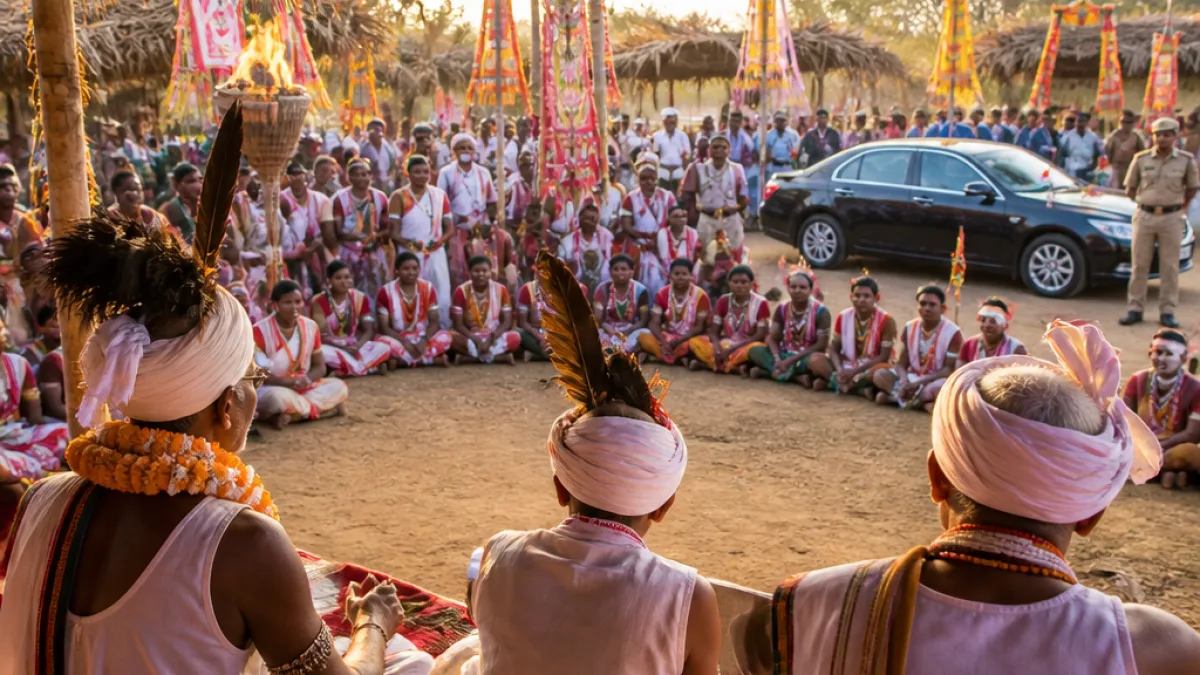
Muria Darbar is not merely a ceremonial stop on the festival calendar. Historically, it served as a public forum where tribal leaders and community representatives — notably the Manjhi and Chalki groups — convened to place local grievances and demands before the ruling authority of the erstwhile Bastar state. The tradition, with roots stretching back into the 18th and 19th centuries, continued after Independence with local administration assuming the role of the former princely ruler in listening to and addressing matters raised by tribal headmen.
Today the Darbar remains an instrument through which community concerns reach the administrative and political establishment. Attendance by the President at the Muria Darbar underlines the continuing symbolic and practical importance of the forum for Bastar’s tribal communities.
Schedule at a glance
| Date | Location | Key engagement | Approximate time |
|---|---|---|---|
| Oct 22 | Raipur (Lok Bhawan, Indoor Stadium) | Release of ₹200 coin & special stamp; Seva Samman Parv; Yuva Probodhan (Nuakhai) | Daytime |
| Oct 23 | Jagdalpur (Danteshwari temple, Sirhasar Bhavan, Lalbagh Maidan) | Visit Danteshwari; participate in Muria Darbar; attend Bastar Dussehra events | Arrive ~10:30 am; Muria Darbar ~11–11:30 am; depart ~3 pm |
Local significance and administrative implications
For Bastar’s tribal communities, the Muria Darbar is a mechanism to present local issues directly in a public forum. The President’s presence is likely to draw attention to long-standing concerns related to governance, forest rights, land use and local development, even if the published programme focuses on cultural and religious observances. The combination of a national commemoration in Raipur and a grassroots forum in Jagdalpur places customary tribal institutions in proximity to state and national ceremonial recognition.
Officials have framed the visit around cultural engagement and observance of customs such as Nuakhai and Dussehra; community leaders view the Muria Darbar as a continuing opportunity to press practical grievances. The scheduled half-hour window for the Darbar is short by tradition’s standards but carries symbolic weight when attended by a head of state.
What to watch for
- Whether specific local demands are formally recorded or taken up with district authorities after the Muria Darbar;
- Any administrative follow-up or public commitments arising from the Darbar; and
- How cultural messaging in Raipur (the coin and stamp release, Nuakhai events) interacts with tribal-centred proceedings in Jagdalpur.
The President’s two-day itinerary underscores the layered cultural and political fabric of Chhattisgarh — from a national commemoration in the capital to a centuries-old tribal assembly that continues to function as a channel for community redress in Bastar.