A city’s traffic culture in the spotlight
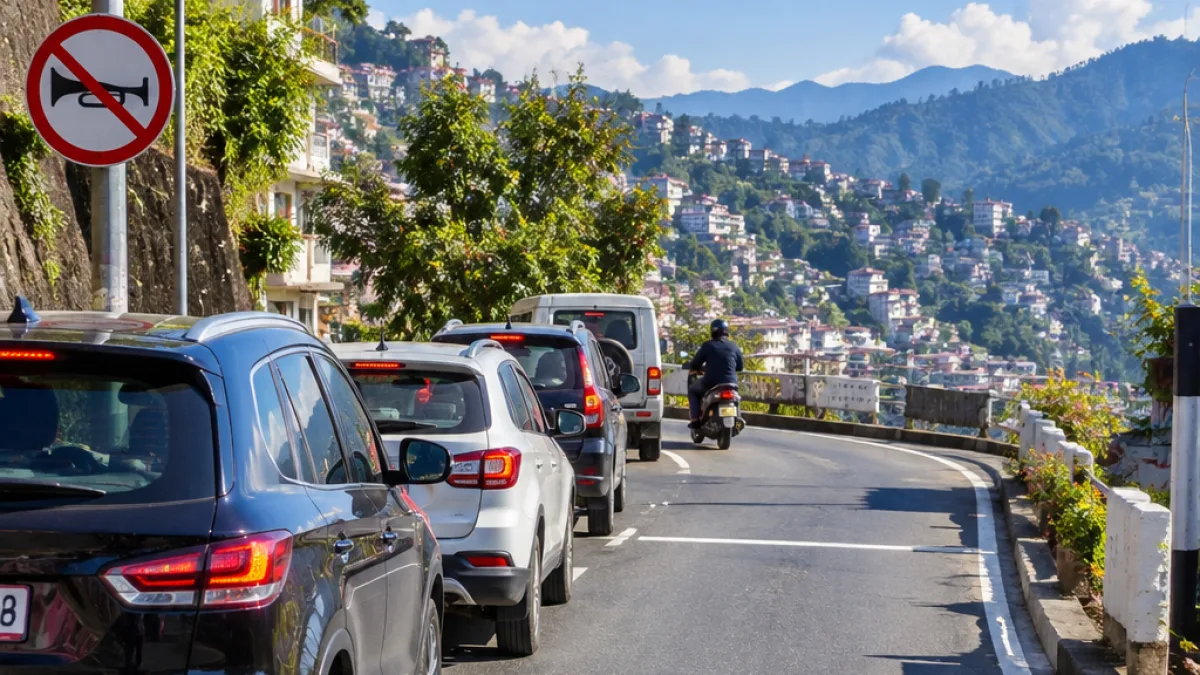
Aizawl has received fresh attention for a civic habit that is often difficult to find on crowded Indian roads: motorists waiting their turn without a steady chorus of horns. Mahindra Group Chairman Anand Mahindra shared a video on November 22 showing vehicles in Mizoram’s capital remaining in their lanes, stopping at signals and avoiding unnecessary noise even when traffic was heavy.
The video features a woman describing the conduct of drivers on an Aizawl road. She points to vehicles waiting in an orderly line and explains that motorists do not move beyond the white road marking while waiting for the signal. Her account presents patience and rule-following as a shared public practice rather than merely an individual choice by a few drivers.
“You can see the traffic here. There’s a lot of vehicles over here. But no horn. It’s all silent because Mizo people got patience and we follow the rules.”
Mahindra, who has previously referred to Aizawl’s traffic discipline, said the city’s motorists showed respect for lane etiquette and followed a no-honking policy introduced in 2017. His latest post reflected on the result of that collective behaviour: quieter roads in a busy urban setting. The observation places everyday traffic conduct at the centre of a broader discussion on how cities can reduce noise without compromising movement.
Patience at signals, respect for road markings
The video focuses on two visible features of Aizawl’s road culture. Vehicles remain behind the designated line at traffic signals, and drivers do not appear to use the horn to pressure others forward. The woman also says that motorists continue to wait quietly during prolonged congestion, including jams lasting two or three hours.
- Lane discipline: Vehicles are shown waiting behind the marked line.
- Reduced honking: Drivers avoid repeated use of horns in congested conditions.
- Signal compliance: Motorists wait for their turn instead of attempting to force a passage.
These practices matter in a hill city where traffic movement is closely connected with limited road space and the behaviour of each road user. The material shared in the video does not present Aizawl as free from congestion. Instead, it draws attention to how drivers respond when congestion occurs. The message is that a queue can remain orderly and comparatively calm even when vehicles are held up.
Quietness as part of the city’s identity
Mahindra’s comments also moved beyond traffic management. He described quietness as an increasingly rare quality in large urban centres, where frequent honking has become associated with daily travel. He suggested that visitors may eventually seek out peaceful surroundings alongside scenery, monuments and other established attractions.
| Feature highlighted | What the video shows |
|---|---|
| Road position | Vehicles wait behind the white line |
| Driver conduct | Motorists remain patient and avoid overtaking the queue |
| Noise levels | Little or no honking while traffic is stationary |
| Policy reference | No-honking policy introduced in 2017 |
The woman in the recording urged people in other Indian cities to learn from Aizawl’s approach, contrasting the capital’s quiet traffic with places where horns continue even during heavy jams. That appeal gives the clip a civic dimension: it is not simply a showcase of a local peculiarity, but a call for greater consideration among road users.
For Aizawl residents, the national reaction offers recognition of a public standard maintained through routine actions—stopping at the correct point, holding position and allowing traffic to move in sequence. It also places responsibility on motorists to preserve the habits that have helped shape the city’s reputation. As the video circulates beyond Mizoram, Aizawl’s traffic culture is being presented as an example of how patience and basic road discipline can influence the sound and feel of urban life.