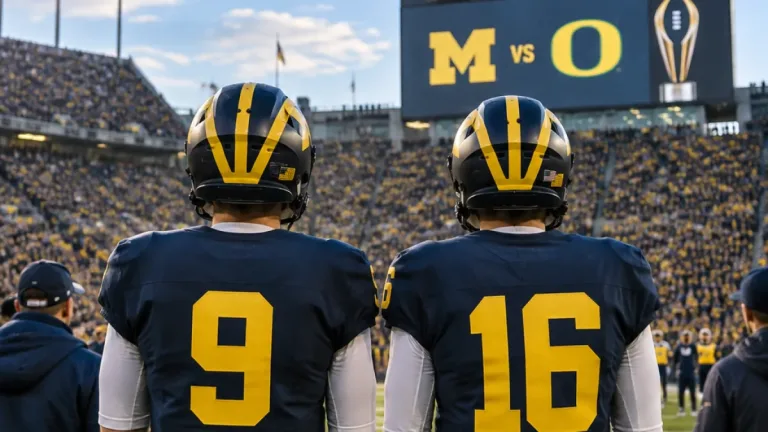
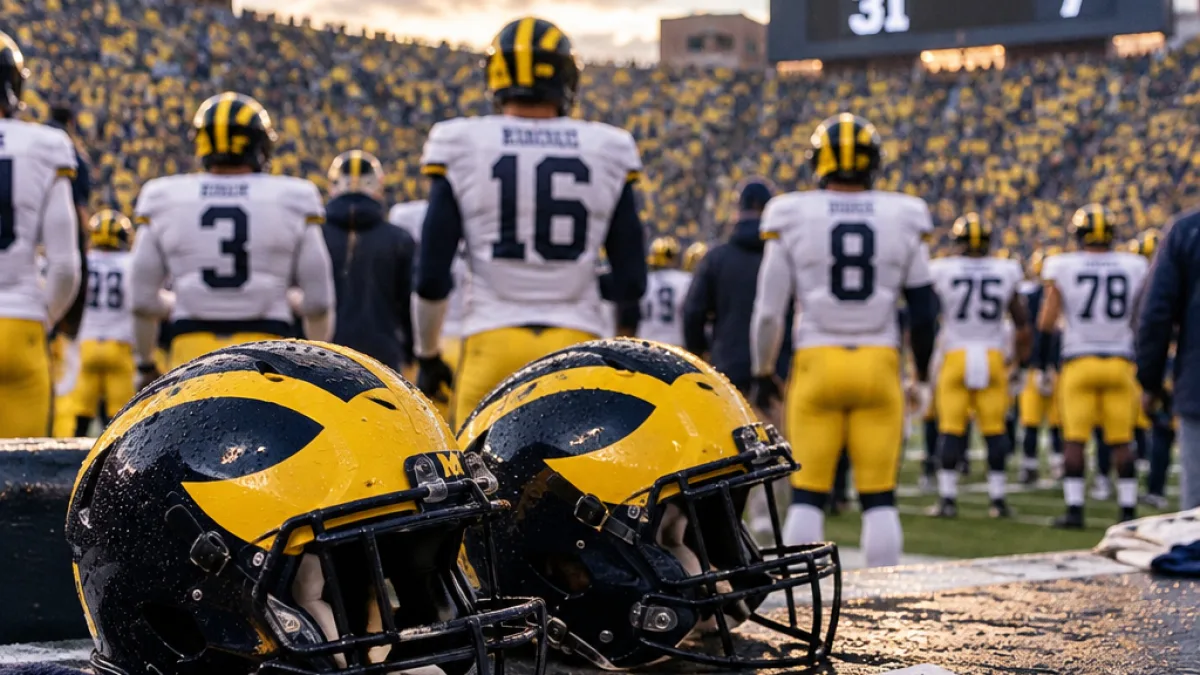
Michigan’s search for a reliable quarterback answer continued Saturday, and the latest experiment did little to steady an offense that has struggled throughout a disappointing season. The Wolverines fell 31-7 at No. 18 Oregon, suffering another heavy defeat on the West Coast as their offensive problems deepened.
A planned change at quarterback
Coach Kyle Whittingham used a deliberate two-quarterback approach, opening with freshman Tommy Carr before turning to sophomore Bryce Underwood. Carr handled Michigan’s first two offensive possessions. Underwood then entered and remained in the game through the rest of the opening half.
The rotation was intended to provide a spark, but neither quarterback was able to generate consistent passing production early. Carr and Underwood combined to complete 3 of 11 passes in the first half, according to the game coverage. That output left Michigan unable to build momentum against an Oregon team that controlled the game and moved the Wolverines farther into an uncomfortable quarterback debate.
| Michigan quarterback | Role described in game coverage | First-half passing result |
|---|---|---|
| Tommy Carr | Started and played the opening two series | Included in the combined 3-for-11 total |
| Bryce Underwood | Entered after Carr and played the remainder of the first half | Included in the combined 3-for-11 total |
The offense remains the central concern
Michigan’s passing game was the most visible weakness in the loss. The early statistics point to an offense that could not consistently complete throws or sustain the kind of rhythm needed to challenge a ranked opponent on the road. The quarterback changes also created a storyline of their own, shifting attention away from any offensive progression and toward which player should receive the next opportunity.
Rather than resolving the issue, the tandem approach produced another uncertain performance. Carr, a freshman, was given the opening assignment, while Underwood returned to action after previously serving as Michigan’s starter. The sequence made clear that the coaching staff was still seeking an answer, even as the season moved forward and the margin for correcting the offense narrowed.
Defensive problems added to the defeat
The Wolverines’ difficulties were not limited to the passing game. Coverage of the defeat also pointed to a defense that struggled against Oregon’s attack. That combination — a stagnant Michigan offense and a defense unable to keep the Ducks in check — allowed the game to become one-sided rather than a close contest decided late.
Michigan entered the afternoon needing a complete performance to leave Oregon with a positive result. Instead, the 24-point margin reflected problems on both sides of the ball. A defense that gives up sustained production places greater pressure on an offense already working through a quarterback rotation, while an offense that cannot stay on the field increases the burden on the defense.
Snap counts and grades will shape the review
The postgame evaluation is expected to focus heavily on playing time and individual performance. Snap counts should help clarify how Michigan distributed opportunities across its roster, particularly at quarterback after the planned switch. Position-by-position grades will offer another measure of where the Wolverines failed against Oregon.
Those evaluations matter because the final score alone does not explain every personnel decision. The quarterback plan, for example, involved a defined opening assignment for Carr and a subsequent role for Underwood. The number of plays each player ultimately received, along with the performance of the offensive line, receivers and running game, will be important to understanding whether the problem was concentrated at quarterback or spread throughout the unit.
A difficult moment for Whittingham
The loss also increases scrutiny on Whittingham as Michigan’s season continues to unravel. The coach made a visible change at the sport’s most important position, but the result was another lopsided defeat. That leaves the program facing questions about its direction, its offensive identity and the best way to develop its young quarterbacks.
For players, the challenge is more immediate than the broader coaching debate. Carr and Underwood are being asked to perform while the team is struggling to establish stability, and the passing numbers from the first half show how difficult that task has become. A clearer plan could help Michigan build continuity, but Saturday’s performance did not provide one.
What comes next for Michigan
Michigan’s next decisions will involve more than selecting a starter. The staff must determine whether to continue alternating quarterbacks, commit to one passer or adjust the offense to reduce the pressure on its young players. It must also address the defensive breakdowns that made a comeback unrealistic once Oregon took control.
- Quarterback: Carr and Underwood combined for 3-for-11 passing in the first half.
- Result: Michigan lost 31-7 on the road to No. 18 Oregon.
- Broader issue: Both the passing offense and defense drew criticism in the defeat.
The Wolverines now have to turn a failed experiment into useful information. Saturday’s result offered no quick fix, but it did establish the urgency of the situation: Michigan needs greater consistency at quarterback, a more functional passing attack and a defensive response. Until those pieces improve, each subsequent game will carry the same question that followed the Wolverines out of Oregon — whether the program can find stability before the season slips further away.