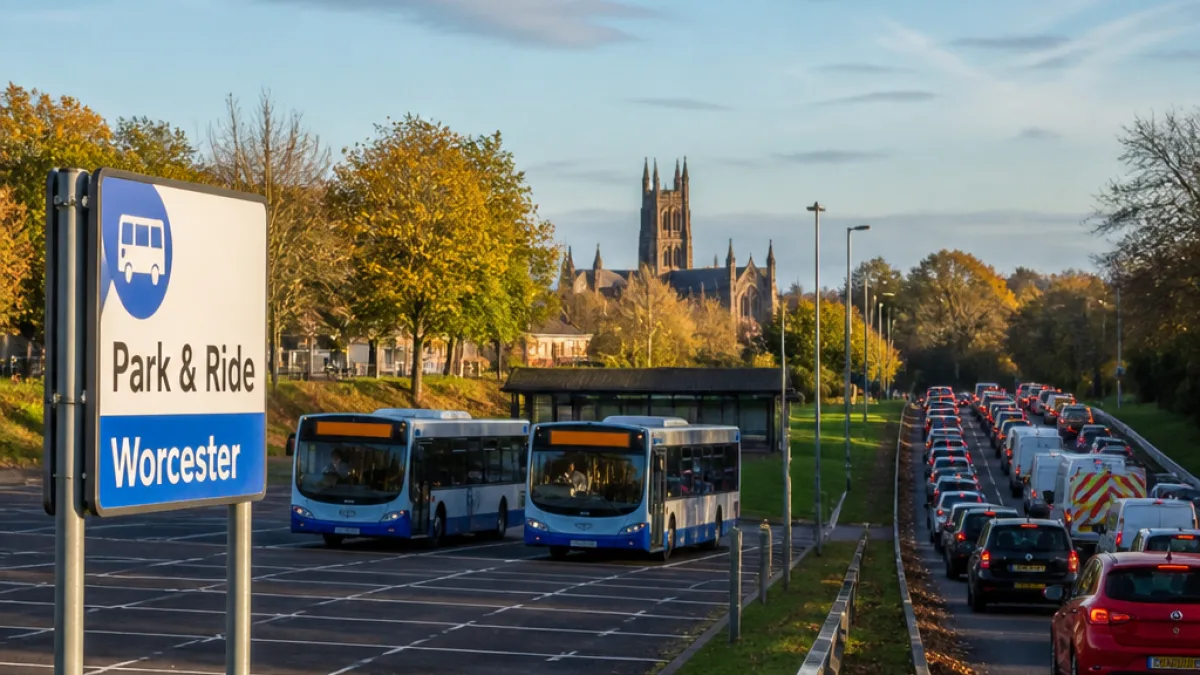
Leader says scheme deserves a second chance after reorganisation
The leader of Worcester City Council has urged a fresh look at bringing park and ride back to the city once the county's local government reorganisation is resolved, arguing the scheme would stand a better chance of success under a single authority.
The call follows memories of a previous park-and-ride trial which, according to councillors, suffered from years of rising prices and a lack of sustained political support. The leader said the current two-tier arrangement between county and city councils hindered long-term decisions on transport and parking.
Why now? Changing governance and worsening congestion
Worcestershire is expected to move to one or two unitary councils by 2028 or 2029 as part of local government reform. Under that model, a single authority would be responsible for transport and parking in Worcester, replacing the present division of responsibilities between Worcestershire County Council and Worcester City Council.
The council leader argued that, with governance consolidated, a park-and-ride service could be better planned, funded and promoted. He also pointed to what he said was a rise in traffic around the city: "If you look at Worcester now you see it down every road going into the city, the congestion has got worse."
- Past scheme: Initially described as successful in its first years but later judged to have failed.
- Price factor: The previous service was undermined by a period of price increases while the city council kept on-street parking charges low or cut them, believing cheaper parking would support the economy.
- Future timing: Reintroduction is suggested after local government reorganisation, likely by 2028–29.
Cross-party response and conditions
Reaction from other local politicians has been cautiously open. Councillor Alan Amos, leader of the county's Reform UK group, said he was not opposed in principle but insisted any park-and-ride must be a "high-quality service" with reliable funding. He also warned that the exact timeline for local government reform remains uncertain.
"It's something I wouldn't rule out. I'm not against the principle of it at all, but something like this must be efficient and reliable," Councillor Amos said.
Amos highlighted the importance of first impressions for public transport, adding that unless the service was dependable people would not use it. His remarks underline a key political hurdle: even if a single authority takes responsibility, delivering a convenient and competitively priced service will be essential to attract motorists out of their cars.
Public appetite and comparable cities
Conversations with residents show interest in the idea. Drivers who face long waits entering or leaving the city have expressed support for measures that might reduce congestion. The council leader compared Worcester to other historic cities operating park-and-ride schemes, naming Oxford, Bristol and Bath as examples where such services operate alongside city centres that are not unlike Worcester.
Those comparisons are intended to signal that park and ride is not a radical or unusual policy for a city of Worcester's size and character. But advocates also concede that success depends on integration with wider transport planning, fare levels and the perceived convenience relative to on-street parking.
| Issue | Needed for success |
|---|---|
| Governance | Clear responsibility under unitary authority |
| Funding | Up-front investment and sustained subsidy/operations funding |
| Service quality | Reliable, frequent buses and competitive pricing |
The council leader said political will had been lacking when the previous scheme was judged a failure. He suggested that, with fewer bodies involved in decision-making and increasing congestion across Worcester, public support could be stronger if a reintroduced service was well presented and properly resourced.
Any formal plan to revive park and ride will depend on the progress of local government reorganisation and detailed work on sites, services and finance. For residents, the debate raises familiar trade-offs between keeping on-street parking cheap to support town-centre trade and using pricing and alternatives to reduce congestion and pollution.
As the county moves towards possible unitary status in the coming years, the question of whether park and ride returns to Worcester is likely to be a recurring feature of local transport planning and electoral debate.